
If you’ve ever looked into protecting a concrete floor or an industrial tank, you’ve likely run into two heavyweight contenders: Epoxy and Polyurea.
For decades, epoxy was the “gold standard.” It’s reliable, widely available, and does a decent job. But as industrial demands have evolved, polyurea technology, specifically Pure Polyurea, is proving to be the preferred choice for high-performance and heavy-duty applications.
At Ultimate Linings, we wanted to stop the “he-said, she-said” and look at the hard data. To ensure a fair, “apples-to-apples” comparison, we took a high-end epoxy and our own XP-461 Pure Polyurea into our ISO-accredited lab to see how they actually stack up. Both were applied at an industry-standard mean thickness of 75 mil.
Here is the “easy-to-digest” breakdown of what we found.
1. The “Glass” vs. “Rubber” Factor (Flexibility)
Think about a sheet of glass versus a sheet of heavy-duty rubber.
- Epoxy is like the glass. It is incredibly hard, but it’s brittle. In our tests, epoxy had an elongation rate of about 13%. This means if your building settles or the temperature changes and the concrete expands, the epoxy is likely to crack because it cannot move with the substrate.
- Pure Polyurea (XP-461) is the rubber. It boasts an elongation rate of over 200%. It’s essentially a “living” coating that breathes and moves with your structure. It stretches where epoxy snaps.
2. Speed: The “Time is Money” Problem
This is often the dealbreaker for businesses.
- Epoxy takes time. You’re looking at a dry time of 1.5 to 5 hours just to touch it, and a full cure can take up to 14 days. That is a long time to keep a facility shut down.
- Pure Polyurea is a speed demon. It becomes “tack-free” in about 5 to 10 seconds. You can often walk on it or return a piece of equipment to service within hours instead of weeks.
3. Strength Under Pressure (Impact & Abrasion)
In an industrial setting, things get dropped and heavy tires grind across the floor.
- The Abrasion Test: We used a Taber Abrasion test, which essentially “sands” the coating to see how much material is lost. The epoxy lost nearly double the material that the XP-461 Polyurea did.
- The Impact Test: When we dropped weights on the coatings, the epoxy showed signs of failure at 30 to 40 inches. The Polyurea did not fail at all, even at the maximum height and energy capacity of our testing machine. It literally bounced back.
4. Application: Detail vs. Scale
There is one area where epoxy still holds a small advantage: simplicity of application.
Epoxy can be applied with a brush, roller, or basic spray kit. It’s a “DIY-friendly” material. Pure Polyurea (such as the XP-461) requires high-pressure, plural-component spray equipment like the Graco Reactor 3. It’s a professional-grade solution that requires specialized training, but that’s exactly why it delivers a uniform, high-performance finish that lasts for decades.
The Verdict: And the Winner Is?
While epoxy is a fine choice for a low-traffic residential garage or a small detail project, it simply cannot keep up with Pure Polyurea in demanding environments.
If you need:
- Extreme longevity
- Minimal downtime (hours versus days)
- The ability to survive impacts and structural shifts
Pure Polyurea (XP-461) is the clear winner.
Want to see the raw lab data?
We’ve only scratched the surface here. Our team put together a comprehensive Whitepaper that includes the full ASTM test results, side-by-side photos of the impact failures, and a deep dive into the application equipment.
Don’t settle for “decent” protection when you can have the “ultimate” solution.
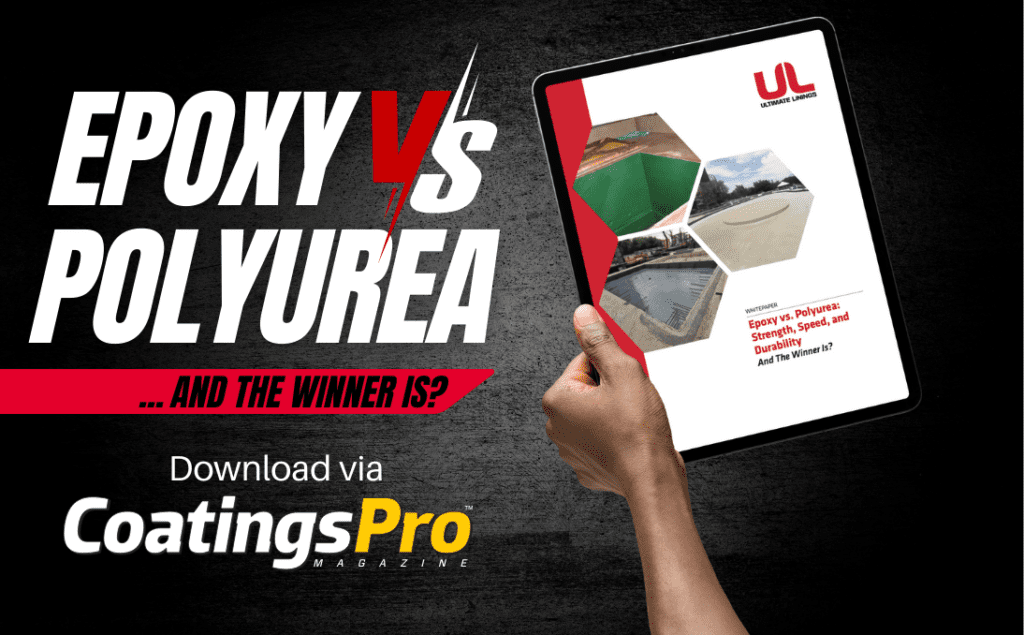 Visit CoatingsPro to Download
Ready to talk about your next project? Contact the Ultimate Linings team at (800) 989-9869 or visit our website.